
Christina DeGrush
Justice for Otsego
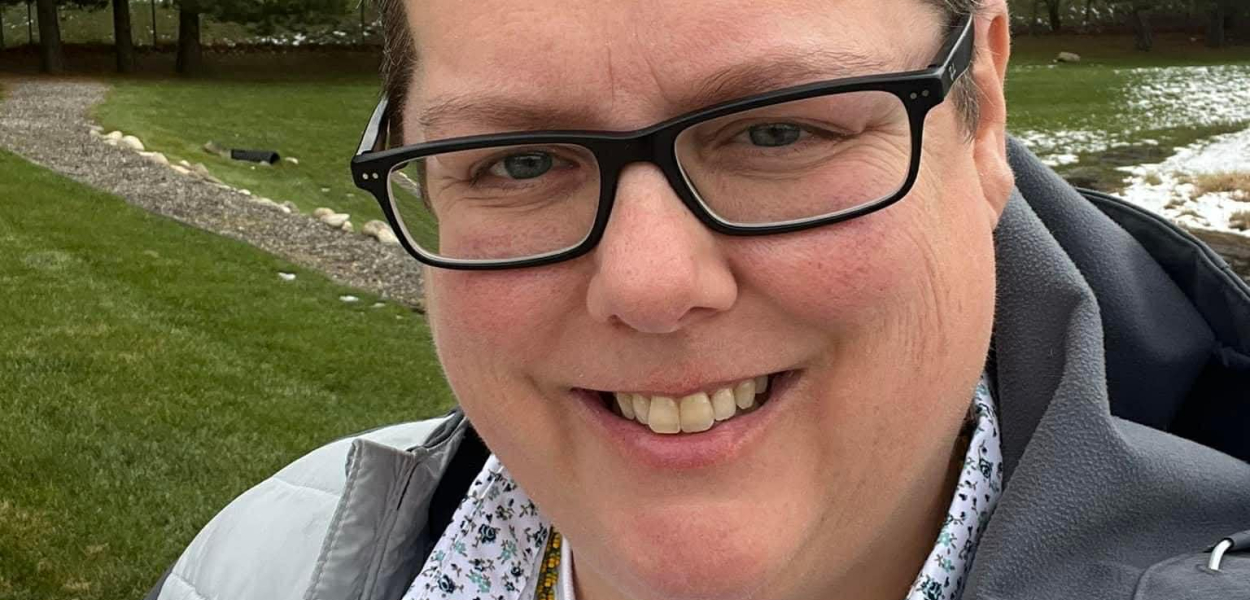
I am a part of Justice for Otsego—I have been, basically, since Mary Zack started the group in 2018. I hadn’t heard anything about any kind of contamination, about the Kalamazoo River being a Superfund site or anything like that until Mary started the group. As I learned about the history of contamination and illegal dumping in this area and the effects this has had on our water, soil, and air quality, I began to think this may have some connection to my own health problems. This got me going, and I’ve been an active member of the group ever since. Mary considered me her “right-hand woman” in the group, and I’m committed to continuing our work.
So, back in 2009, when I was 31 years old, I started having terrible, terrible headaches. I started losing my peripheral vision. I had a history of migraines, so I didn’t think much of the headaches at the time. Losing my vision was what really made me go to the doctor. The pain from the headaches became extreme, more than any migraine I had ever had. That’s what sent me to the ER.
At first, the doctors thought I had brain cancer until I went to an actual neurologist and received my diagnosis—a Rathke’s cleft cyst. This is a benign tumor that grows on my pituitary gland. It has regrown many times even though I’ve had a total of six brain surgeries to try and get rid of it. Because of all these tumors, my pituitary gland is now nonfunctioning, so I am on complete hormone replacement therapy. I also now have other health issues like ulcerative colitis and diabetes. I take steroids, so I have the classic “moon face” and I’m told I have brittle bones. I’m losing my teeth and other things like that.
“Sure, my tumor is considered benign because it’s not cancerous, but the effects on my life have been pretty drastic. Before this, I was fully immersed in the working world, doing whatever I wanted, when I wanted. And now, I’m disabled. I can’t work. I am limited in how much I can do.”
After the first surgery, I went back to work and initially felt fine. Within two months I was back in the hospital having my second brain surgery. In two months! The tumor had grown back immediately. Other members of my family have also been affected.
My brother died of brain cancer in February 2023, a glioblastoma. He was 49 when he was diagnosed and died less than a year later. We both grew up in Otsego. Our house was right next to a natural spring creek which flows from a meat packing plant into the Kalamazoo River where Brookside Park is located. We used to play in that creek all the time. We walked across it every day when we went to school.
The same year my brother died, we lost my cousin Beth. She was a missionary. She was in Peru. She grew up on the Kalamazoo River as well in Fulton, Michigan. Our core family is in Galesburg, and that’s on the Kalamazoo River. Beth passed from uterine cancer. I think she was 40 or 41 when she died. Her sister Lisa has treatment-resistant Chron’s disease. I also lost two of my uncles. One being Beth’s father, my uncle Dennis. He had an aggressive form of bone marrow cancer. He was also in the military and was exposed to Agent Orange. My other uncle, my uncle Mark, passed from lung cancer. That was all within about a year and a half.
And just a couple months ago, my dad passed of pancreatic cancer. He had also battled spindle cell rectal cancer. My mom is still with us, and she is a cancer survivor—she had endometrial cancer and had a full hysterectomy in her mid-50s.
All this loss doesn’t make sense. I’m certainly not an expert, but I certainly think that having all these different kinds of cancer is not normal, especially when there’s not a longer history of it in the family. And rare diseases like mine, there’s no history of that either. As far as we know, all our grandparents died of natural causes.
It’s really affected the generation of my parents and my generation and going forward. The children of the late 70s and early 80s.
“We’ve been programmed to think this is normal. It’s not normal. I 100 percent think it’s environmentally caused.”
If I open my yearbook, I can point out who has difficulties with their health, who has passed. I’d be pointing to nearly every person in my graduating class. There’s also a lot of immune problems in my community. A lot of PCOS—polycystic ovary syndrome. A lot of thyroid problems. I mean, if there’s a disease you can think of, we have it. Super rare diseases like mad cow disease—CJD—we’ve got it. The list is endless.
This is a big paper-making town, but it never seems to grow. We always have about 4,000 people. Otsego Paper makes paper for drywall in the former Menasha factory. RockTenn made corrugated cardboard things. I’m not positive what Simpson paper made, so I won’t say. They made paper of some sort. Everybody in town worked in one of the paper mills, basically. And then, one day, the jobs just disappeared. Seemingly overnight. RockTenn told their employee they were closing in a week, and they closed their doors even earlier. It was similar for Menasha. Many people were left without a job, without a clue the factories were closing.
Menasha was involved in the lawsuit for the Kalamazoo Superfund site, they were found not liable for the PCBs in the river. So, once that was all cleared they closed shop and left town. But, as we’ve discovered recently, they have a lot to do with the PFAS in the area. Spreading it on farms. Having it in landfills. It’s a mess.
So, Justice for Otsego shares information on all of this. We have two Facebook pages: “Justice for Otsego Discussion Group” is a private group so people can share their stories, information, whatever they have to say about the community and surrounding areas. We also have “Justice for Otsego” which is public, purely information. Only myself and a few other admins can post on it.
We have a lot of community response. Mary, in the early time of Justice for Otsego, made a survey and circulated it online. We had close to 1,000 responses. For a community of about 4,000 I think that’s pretty good. It was heartbreaking reading everyone’s answers to the survey.
The very first meeting Mary did was at the Otsego Library and the room was standing-room only. It was packed. People from the CDC, state and county health departments, the then Michigan Department of Environmental Quality, now EGLE, were all there.
They then went and tested. They made a map of places where they knew sludge was spread on farms and of wells where they found PFAS. They would do meetings on their findings and it felt like there was never anything new. They would present some data and tell us we shouldn’t worry about it, that they’d take care of it.
“At first, we were very excited about having all of these organizations coming to our rescue, so to speak. We ended up very disappointed.”
The community is left thinking that they don’t care. We’re not even sure that what they tell us is true or not. There’s a lot of skepticism about their actions and if things have been covered up between them and the city itself and the township. I don’t like to think that, I’d like to think they are working on our behalf, on our side. But it's hard not to feel paranoid. There’s no trust.
Communication between the agencies and the community is not great. It needs to be improved. No one had ever heard of the Kalamazoo Superfund site. No one had heard of the A1 Waste illegal landfill. People just didn’t know. It wasn’t communicated.
I do think that every test done by EGLE or the EPA should be made public. Sure, you don’t have to publish the addresses, but the data should be made public. And if it is already public, people don’t know how to access it because it’s not communicated how to access it. I do a lot of research, and it is very hard navigating the EGLE and EPA websites. You spend hours and hours looking. The sites need to be made easier for people to navigate. I’ve been doing this since 2017, and even for me, knowing how the website is, it takes me hours to find information. You really have to go down this rabbit hole, looking all over the place, trying to find this information. It’s almost impossible. It feels like the agencies are making this information hard to find on purpose.
I believe there are more chemicals out there that are not being talked about, like dioxins. That’s another trust issue. Some years back, the Otsego City wells were tested and found to have low levels of dioxin in them. And then they turned around and said it was a lab error because they were using dirty beakers that had Otsego water in it, so it wasn’t actually Otsego water that had dioxin. So how many places have dioxin in the water that the lab would already be contaminated? It just doesn’t make sense. I am concerned that we might find low levels of dioxin if we tested it today.
I don’t use the water here. I don’t drink it. I buy all my own water. That’s a problem within itself because then you are consuming microplastics and all that. I honestly could probably drink the tap water; the damage is already done to me. My concern at this point is not me, it’s about future generations.
I think we need to hold the corporations accountable, to pay people’s medical bills. For example, my very first surgery with all the testing and things before hand was one million dollars! If I didn’t have insurance, there’s no way I would have been able to do that. And I had SIX of these surgeries! People don’t have millions of dollars. These corporations need to pay for what they did. It seems paying people’s health expense is the least they can do. They need to be responsible and clean up their mess.
“I think about this every day. Every day, every minute. It’s what drives me to do what I’m doing. The answers are there, we just have to push to get them, and I won’t stop until we get them. I’ll either die not knowing, or I’ll die knowing I did the work to get the answers.”
What does “Justice for Otsego” mean?
Gallery
Related Stories
-
You can certainly make a mistake, all of us will, but when you are harming others, and are not taking accountability, that’s negligence.
-
I am a 29-year-old cancer survivor. I never expected this to be part of my introduction. I would love for my introduction to just be that I’m a mom.
-
Our biggest mistake is thinking it’s not going to happen to us and always thinking we’ll have the time.